We combine mathematics, data science, and bioinformatics to investigate how bacteriophages drive the ecology and evolution of microbial communities — from hospital pathogens to natural environments.
Bacteriophages — or phages for short — are viruses that infect bacteria. With an estimated 1031 particles on Earth, they are the most abundant biological entities on the planet, outnumbering bacteria ten to one. Wherever bacteria thrive — in the ocean, soil, the human gut, and hospital wards — phages are there too, relentlessly preying on them.
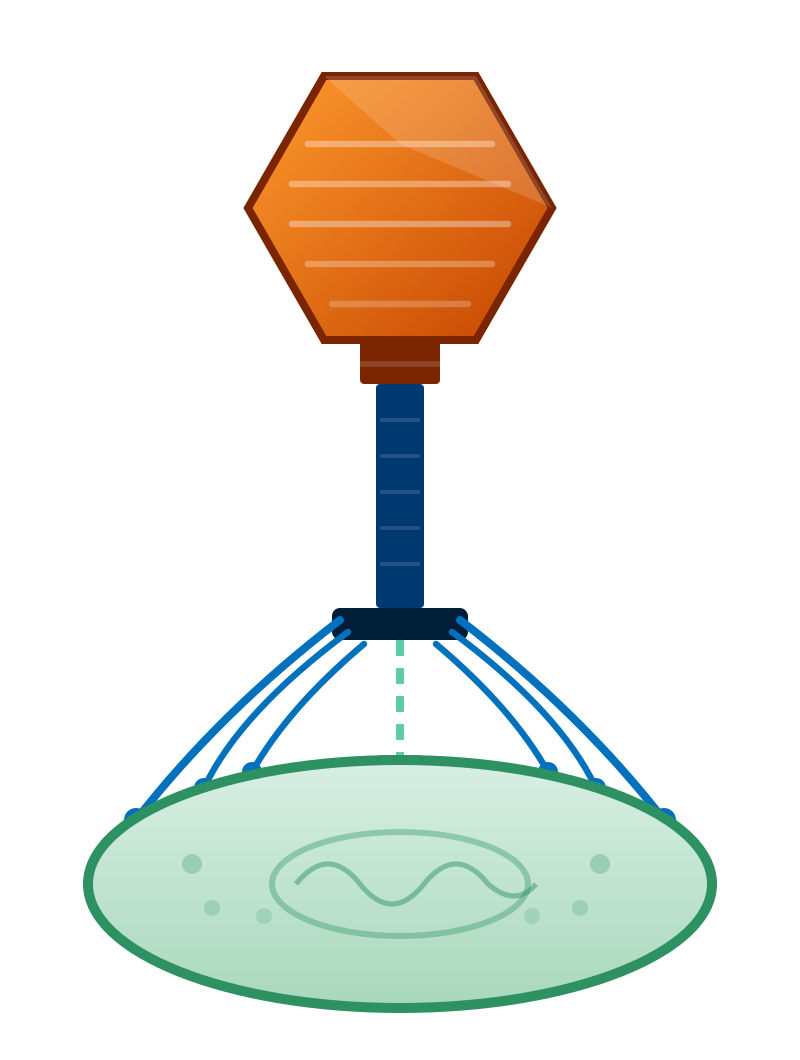
Phages work by latching onto a bacterial cell, injecting their genetic material, and hijacking the cell's own machinery to replicate. The bacterium either bursts open releasing new phage particles, or the phage quietly integrates into the bacterial chromosome — becoming a prophage — lying dormant for thousands of generations. These hidden passengers are far from inert: prophage genes can rewire their host's biology, conferring virulence, antibiotic tolerance, and the ability to colonise entirely new environments.
In an era of rising antibiotic resistance, phages are also gaining attention as therapeutics — precision biological agents capable of targeting pathogens that drugs can no longer reach. Understanding the ecology and evolution of phage–bacteria interactions sits at the heart of our research.

We sit at the intersection of microbial genomics, evolutionary theory, and quantitative biology.
How do integrated phage genomes equip bacteria to thrive in radically different environments — from hospital wards to agricultural settings? We analyse thousands of bacterial genomes to find out.
We develop mathematical models and computational tools to predict phage resistance emergence and understand the coevolutionary arms race between phages and their bacterial hosts.
Using mathematical models and data science, we explore how competition, cooperation, and public goods dynamics shape the long-term ecology and evolution of microbial populations.
The Phage Ecology and Evolution Group, led by Dr Bogna Smug, uses a combination of mathematical modelling, data science, and bioinformatics to study how bacteria and their viruses interact, co-evolve, and shape one another's ecology.
We are based at the Faculty of Science, University of Ostrava, and are actively recruiting motivated researchers to join us.
Large-scale genomic and metagenomic analysis
Quantitative frameworks for evolution and ecology
Statistical learning and computational prediction
Updates from the lab.
We are actively recruiting a PhD student and a Postdoctoral researcher to join the group. Both positions are funded and are focused on phage genomics, bacterial adaptation, and computational biology. See the Join Us page for full details.